
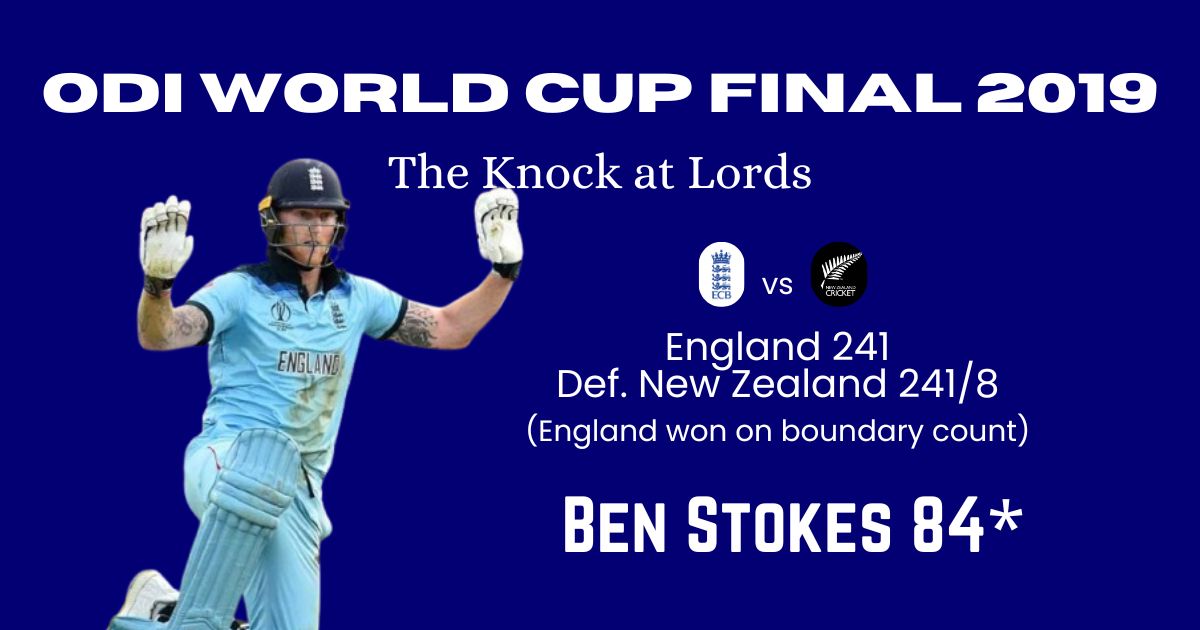
Ben Stokes’ 84 in the World Cup Final 2019: A Knock for the Ages
There are moments in sport that transcend the boundary rope. Moments so dramatic, so packed with narrative and raw emotion, that they become seared into the collective memory of a nation. For English cricket, the summer of 2019 was a seemingly endless carousel of such moments, but none shone brighter than Ben Stokes’s immortal 84 not out in the ICC Cricket World Cup final at Lord’s.
Facing a red-hot New Zealand side on a tricky pitch, with the weight of a 44-year wait for a World Cup on his shoulders, Stokes produced an innings of such grit, intelligence, and sheer force of will that it defied logic. It was an innings that, against all odds, dragged England from the depths of despair to the pinnacle of the sport, forever etching his name into the pantheon of English sporting greats. This is the story of that extraordinary knock and why, despite its controversial finale, it stands as the greatest innings in World Cup history.
The Crucible: England on the Brink
To truly appreciate the magnitude of Stokes’s heroics, one must understand the context of the cauldron in which they were forged. New Zealand, winning the toss and batting first on a slow, two-paced Lord’s pitch, had posted a modest yet highly challenging total of 241 for 8 . The surface was a bowler’s paradise, making strokeplay difficult and run-scoring a laborious task. Chris Woakes and Liam Plunkett starred for England, taking three wickets each to restrict the Black Caps . While 241 seemed below-par for a team like England, renowned for its explosive batting, the pitch told a different story. It was a total that demanded absolute concentration and a calculated approach.
When England’s reply began, the pressure was palpable. The early loss of Jason Roy to a brilliant Matt Henry delivery was a blow, but it was the middle-order collapse that sent shockwaves through the home dressing room. Joe Root, the anchor, fell cheaply to the metronomically accurate Colin de Grandhomme, edging to the keeper . Captain Eoin Morgan, after a barrage of short balls, was brilliantly caught by a leaping Lockie Ferguson at deep point . When Jonny Bairstow was bowled by Ferguson for 36, England were reeling at 86 for 4 . The dream of lifting the World Cup on home soil was rapidly fading into a nightmare. The entire tournament, the four years of preparation, and the nation’s hopes rested squarely on the broad shoulders of Ben Stokes.
The Rescue Act: Building a Foundation with Buttler
Stokes was joined by his great friend and fellow finisher, Jos Buttler. What followed was a masterclass in pressure management. They understood that on this pitch, there was no room for extravagant stroke play. The pair embarked on a cautious yet defiant rebuilding process, rotating the strike meticulously and punishing only the very loose deliveries. Their partnership of 110 from 133 balls was the bedrock of England’s entire chase .
Buttler, the more fluent of the two, brought up his fifty with a delicate carve over the covers, while Stokes, characteristically, was all grit and determination. He wasn’t just batting; he was waging a war of attrition, soaking up the pressure from the relentless New Zealand attack. For Stokes, the mindset was clear. As he later reflected, rather than thinking, ‘I can’t get out now,’ he was thinking, ‘Right, what do I need to do now?’—a crucial distinction between fear and positive intent .
Just when the partnership was steering England towards the target with 46 needed from 31 balls, Ferguson struck again, having Buttler caught on the boundary for a well-made 59 . The pendulum had swung once more. When Chris Woakes fell soon after, the equation became a daunting 39 required from 23 deliveries.
The Final Over: A Microcosm of Chaos and Genius
The 50th over, bowled by the left-arm genius Trent Boult, began with England needing 15 runs. The tension was unbearable. The first two balls yielded nothing; two dots, and the required rate ballooned. With the strike firmly held, Stokes knew he had to act. Ball three: he cleared his front leg and launched a colossal heave over deep mid-wicket for six. Nine runs needed from three balls. Game on.
Then came the moment that would spark a decade of debate. Stokes mishit a yorker-length ball towards deep mid-wicket and set off for a desperate second run. As he dived to make his ground, the fielder, Martin Guptill, unleashed a powerful throw at the striker’s end. The ball struck the diving Stokes’s bat and ricocheted at lightning speed to the third-man boundary. The umpires signalled six runs: two for the run and four overthrows. England suddenly needed just three from two balls .
In the chaos that followed, Adil Rashid was run out, leaving three needed from the final ball. Stokes, displaying the clarity of thought that defines all-time greats, held his nerve. As he later revealed, his mind flashed back to Bangladesh’s defeat to India in the 2016 T20 World Cup, where they lost their wicket trying to hit a boundary and fell short . “Don’t try to be a hero,” he told himself . He pushed the ball into the gap for a single, but Mark Wood was run out attempting the second. The scores were level. A Super Over would decide the World Cup.
Tactical Match Analysis
The Tactical Genius of Stokes’s Knock
Beyond the raw drama and emotion, Stokes’s 84 was a tactical masterpiece. He didn’t just swing his bat; he managed the game with a chess master’s precision. Here’s a breakdown of the key tactical elements of his innings.
- Manipulating the Strike: When batting with the tail (Liam Plunkett, Adil Rashid, Mark Wood), Stokes took on the role of the senior partner to its highest degree. He farmed the strike, refusing risky singles and exposing the less capable batsmen only when absolutely necessary. This ensured England’s best chance of scoring was always at the crease .
- Match Awareness vs. de Grandhomme: Colin de Grandhomme bowled 10 overs on the trot, conceding just 25 runs and taking the wicket of Root . Stokes recognized that taking risks against him was futile. He respected his nagging line and length, accumulating quietly and targeting the other bowlers, a crucial factor in keeping England in the hunt without collapsing further.
- Understanding the Surface: Stokes didn’t attempt to play the fluent, 100-strike-rate innings England were famous for. He understood the pitch was slow and that patience was the only path to victory. His strike rate of 85.7 was a testament to his adaptability and his willingness to put team needs above personal glory.
- The Six off Boult (Ball 3): This was a premeditated, high-percentage shot. With the field up and the equation demanding a boundary, Stokes backed himself to clear the shorter boundary. It was a calculated risk, born of immense self-belief and a clear understanding of the required rate.
- The Last Ball Decision: The most tactical decision of all. With one run needed, the temptation to swing for the fence and become the immortal hero would have been overwhelming for most. Stokes, however, recalled Bangladesh’s mistake. He calculated that getting a single and taking the game to a Super Over, with the in-form Jofra Archer to bowl, gave England a 50% chance. Swinging and getting out gave them zero. It was the ultimate display of match intelligence under extreme duress .
The Controversy: The Overthrow Rule
No analysis of Stokes’s innings is complete without addressing the elephant in the room: the controversial six overthrows. While not Stokes’s fault, the incident sparked intense debate and led to a change in the laws of the game. Former ICC umpire of the year, Simon Taufel, pointed out a crucial error in the umpires’ decision-making. According to Law 19.8, the batsmen are only awarded an extra run for overthrows if they have crossed for the second run at the moment the fielder releases the ball . Replays showed that Stokes and Rashid had not crossed when Guptill released the throw. Therefore, England should have been awarded only five runs for the incident (the two they ran, plus three for the boundary), not six .
The “what if” scenario is tantalizing. With four needed from two balls instead of three, the dynamics of the final two deliveries would have been completely different. New Zealand captain Kane Williamson’s calm, understated reaction in not arguing the decision was questioned by some, who felt a more aggressive captain might have contested it . The ICC later changed the rules regarding such deflections, but for Stokes and England, the moment was written in the stars. As Stokes himself said, “When something like that happens you know it’s just meant to be” .
The Super Over and Redemption
Exhausted but unbowed, Stokes walked back out for the Super Over with Buttler. The adrenaline had taken over. They smashed 15 runs off Boult’s over, a total that felt just about defendable . Then came the final twist of the knife. As Jofra Archer prepared to bowl the most important over of his young life, Stokes approached him. He drew on his own darkest hour—the 2016 World T20 final where he was hit for four consecutive sixes by Carlos Brathwaite—and offered simple, profound advice: “Whatever happens, it’s not going to define your career” .
This was the ultimate vindication of Ben Stokes. The man whose career might have been defined by a single moment of failure was now using that same experience to steady a teammate. When Archer held his nerve and Guptill was run off the last ball, England were champions. Stokes fell to his knees, the release of four years of pressure, controversy, and relentless hard work pouring out in an instant. He had not only exorcised the ghost of 2016 but had transformed it into the fuel for English cricket’s greatest triumph .
Conclusion: A Legacy Forged in Fire
Ben Stokes’s 84 not out in the 2019 World Cup final was far more than just a number on a scoreboard. It was a tapestry woven with threads of resilience, tactical genius, raw power, and an unshakeable belief in the face of overwhelming odds. It rescued England from the abyss of defeat, navigated the chaos of a controversial ricochet, and set the stage for a Super Over victory that would unite a nation.
His 84 ensured the match was tied, and his composure in the Super Over helped seal the trophy. It was an innings that single-handedly changed the course of English cricket history. In the pantheon of great World Cup knocks, from Kapil Dev’s 175 to Aravinda de Silva’s unbeaten century, Ben Stokes’s 84 stands alone. It was an innings played not on a flat batting paradise, but on a treacherous surface under the most intense pressure imaginable. It was, and will remain, the greatest innings in the history of the Cricket World Cup .